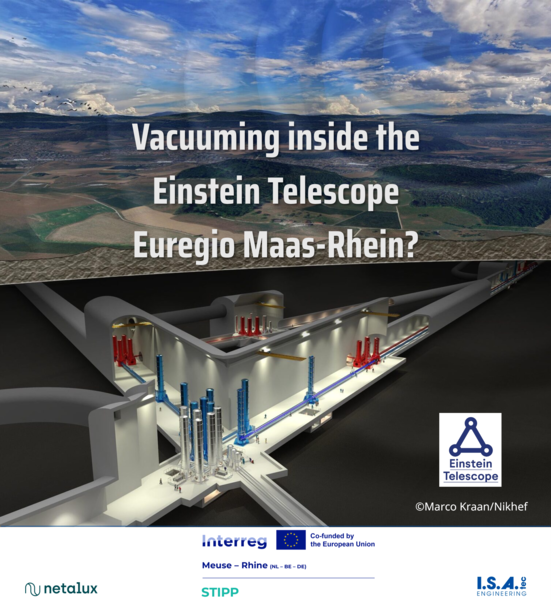
The tubes are part of a concept for the Einstein Telescope, a future observatory for gravitational waves from universe. The telescope is planned to be built at a depth of up to 200 m with three 10-km-long arms arranged in a triangle. These arms contain several tubes through which laser light is emitted. Gravitational waves can be detected using highly sensitive detectors.
To enable these precise measurements, the tubes -which operate under ultra-high vacuum- must be extremely clean. There can be no more than 293 particles measuring 5 micrometers per cubic meter of air - a level undetectable to the human eye. By way of comparison: Some bacteria are 5 micrometers in size, while a human hair is 50 to 100 times thicker.
One solution for the cleaning process is a module that combines a laser and a vacuum cleaner. The laser beam removes dust particles from the inner tube, which are then immediately sucked up by the vacuum cleaner. This cleaning module must clean the interior of all tubes required for the measurements -a total of approximately 120 km- across their full length and around their entire 360-degree circumference, before the planned observatory can become operational.
To analyze the feasibility of the cleaning module, the cleaning process was simulated and evaluated using CFD (Computational Fluid Dynamics) software. Thanks to the expertise of ISATEC the study serves as the basis for the potential production of the cleaning module in collaboration with netalux.
Now, research institutes and companies in the Netherlands, Belgium, and Germany must work closely together to secure the contract from the European Commission for the construction of the Einstein Telescope in our border region.
> Click here to watch the video!
Further informationen about the Einstein Teleskop:
https://www.einsteintelescope-emr.eu/en/
https://www.einstein-teleskop.de/news/
https://www.interregmeuserhine.eu/en/projects/stipp/